The First Watch platform

Onboard control. Shore-side clarity.

Two halves of one system. First Watch Vessel keeps the engine room and bridge in control at sea. First Watch Cloud gives everyone ashore the same live picture.

On board

First Watch Vessel

  • Machinery alarm and monitoring HMI for the bridge and engine room
  • Redundant design: a standby takes over if the active unit fails
  • Runs fully standalone, with no internet connection required at sea
  • Tank gauging: soundings to volume and tonnes on board, with trim correction
  • Onboard historian buffers every reading for the shore link
Ashore

First Watch Cloud

  • Fleet map with live position, health score and alarm count per vessel
  • Fleet fuel consumption, per vessel and per engine, with efficiency
  • Live dashboards, alarm center, trending and analytics in any browser
  • One-click PDF reports for management, class or audit
  • Optional: switch it on now or add it later

On board

Screens built around your vessel.

Every system gets its own live screen, drawn to the equipment actually installed.

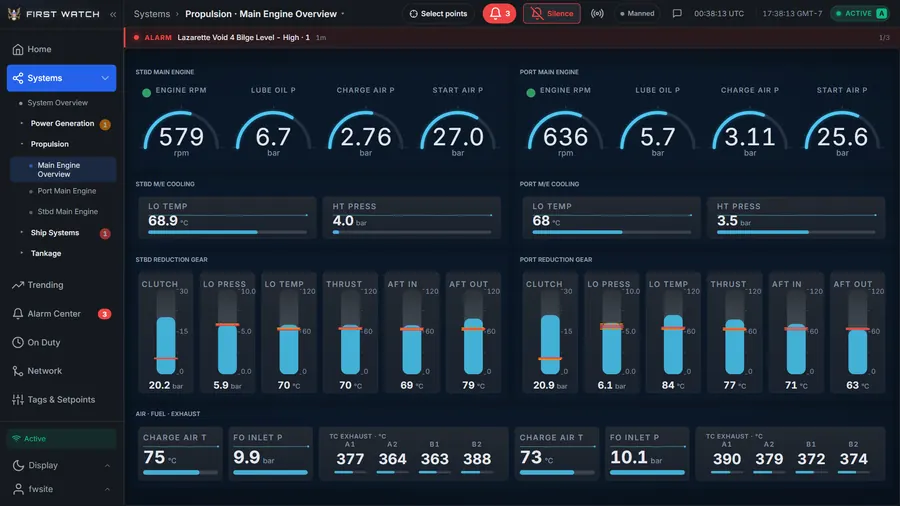
  • Main engine overview screen: port and starboard engine RPM, lube oil, charge air and start air gauges, cooling, reduction gear bars and turbocharger exhaust temperatures
    Main engines · port and starboard side by side, to the gearbox
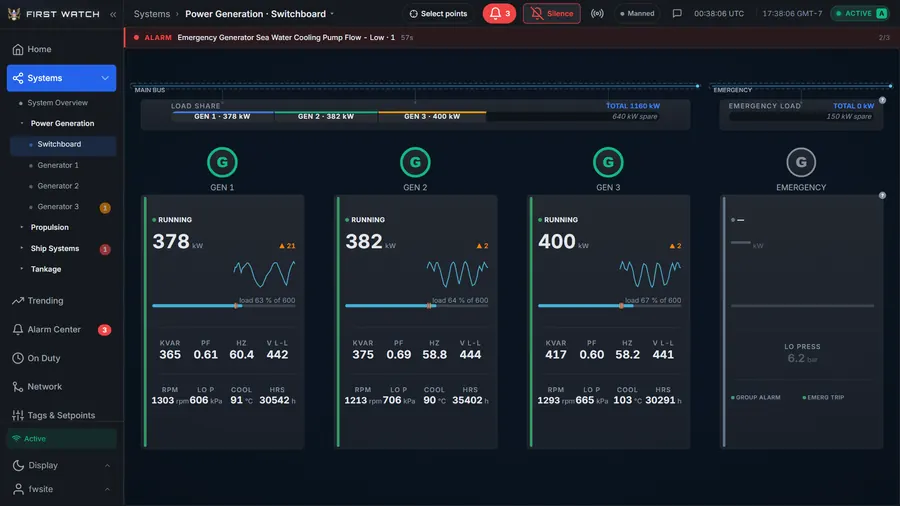
  • Switchboard screen: three running generators sharing the main bus load with kW, kvar, power factor, frequency and voltage, plus the emergency generator
    Switchboard · load share across every generator
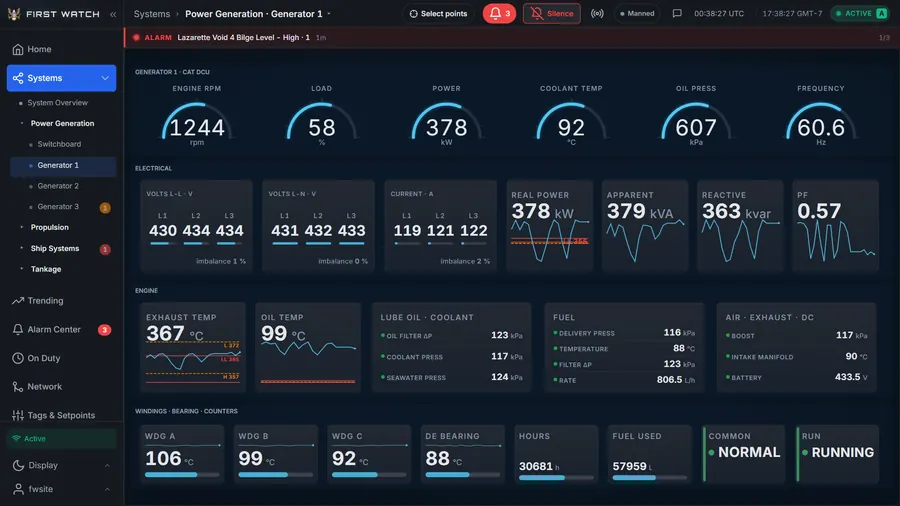
  • Generator detail screen: engine RPM, load, power, coolant, oil pressure and frequency gauges, per-phase volts and amps, live real, apparent and reactive power trends, and winding and bearing temperatures
    Generator · engine, electrical and windings on one page
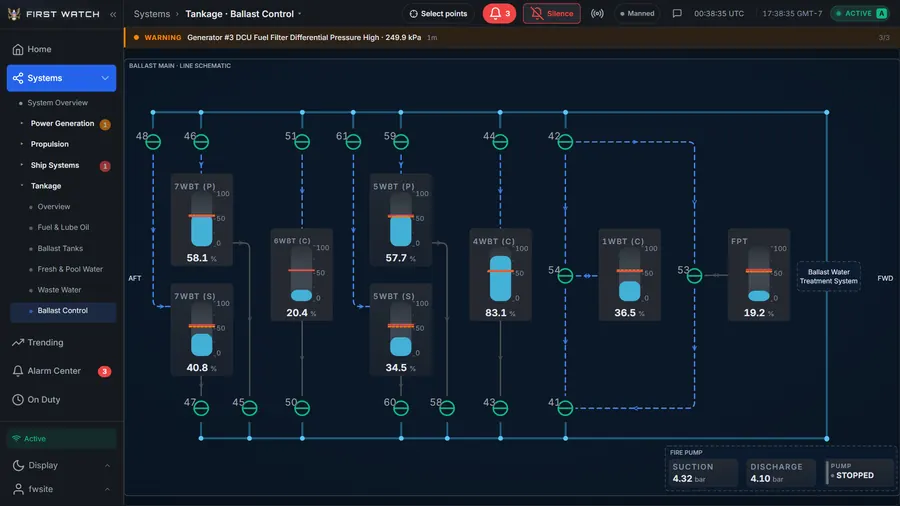
  • Ballast control line schematic: ballast tanks with live levels, numbered valves and the ballast main from aft to forward, with fire pump suction and discharge pressure
    Ballast control · tanks, valves and the ballast main

Inside First Watch

Know what's wrong, where, and why.

The same screens on the bridge, in the engine room and ashore.

01 · Fleet Command · Cloud

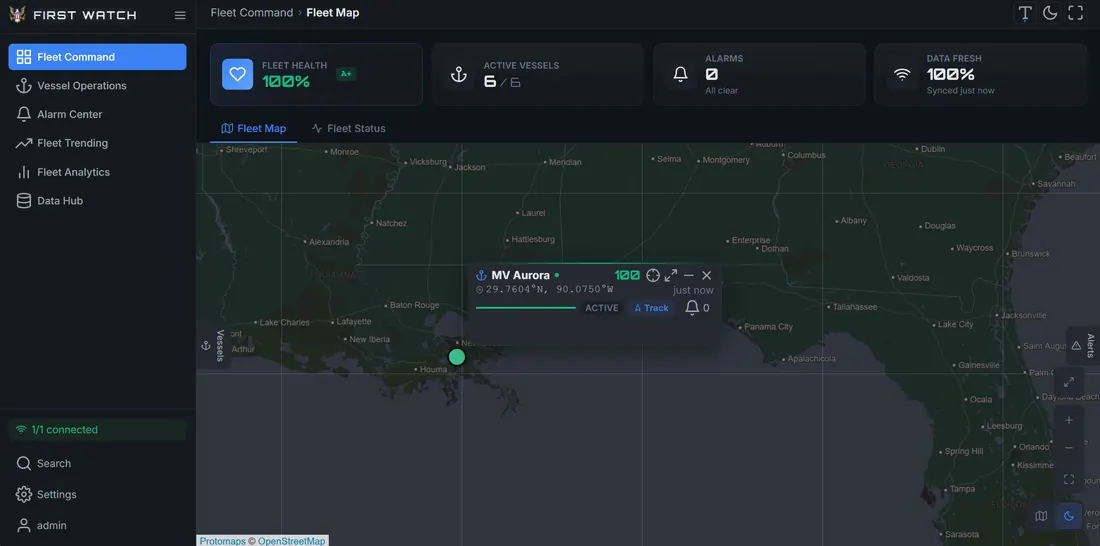
Your whole fleet on one map.

Every vessel's live position, health score and active alarms at a glance. The vessel that needs attention rises to the top. Click one to see heading, speed, systems and its recent track.

First Watch Fleet Command map showing vessel MV Aurora near Louisiana with fleet health 100%, six of six vessels active and no alarms

02 · Fuel reporting · Cloud

Know where every gallon goes.

Rank the fleet by fuel burned over the last day, week or month, then open any vessel to see each main engine, generator and FiFi pump on its own card. Fuel that no engine meter accounts for is shown as unattributed, not hidden.

  • Gallons per load-hour fleet-wide; gallons per kWh once an engine's rating is entered
  • Meter resets, glitches and data gaps caught and flagged, with an audit trail
  • Metering coverage shows which engines can report fuel and what the rest need

Sample Fleet Consumption view for the last 30 days: 58,940 gallons burned across the fleet at 9.4 gallons per load-hour. Four vessels are ranked by fuel burned, from 18,420 down to 9,870 gallons; one shows 6 percent unattributed fuel and one had a meter reset detected and corrected. A fifth vessel with no fuel metering is listed separately rather than as zero.

Illustration of the Fleet Consumption view · sample data

03 · Engine screens · Vessel & Cloud

Every engine, drawn as it's built.

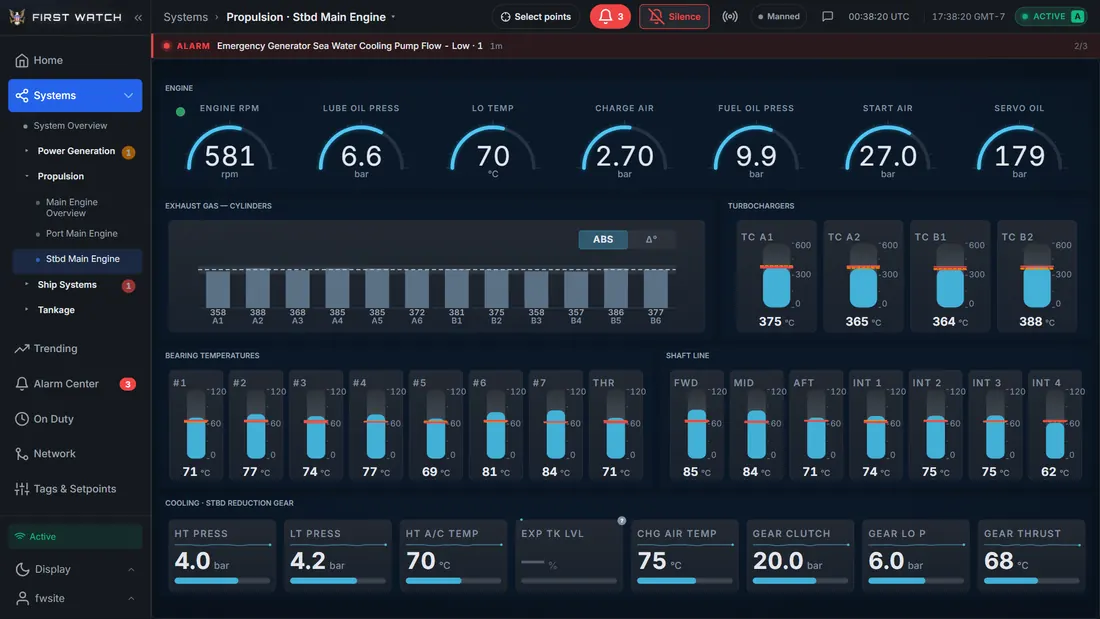
RPM, lube oil, charge air, fuel, start air and servo oil across the top. Below: exhaust temperature for every cylinder, each turbocharger, every main bearing, the shaft line and the reduction gear. The screens are built to your actual machinery, and every value updates the moment it changes.

First Watch Vessel starboard main engine screen: RPM, lube oil, charge air, fuel oil, start air and servo oil gauges, exhaust gas temperature for twelve cylinders, four turbochargers, main bearing and shaft line temperatures, and cooling and reduction gear readings

04 · Home & alarms · Vessel & Cloud

Only what needs a human reaches a human.

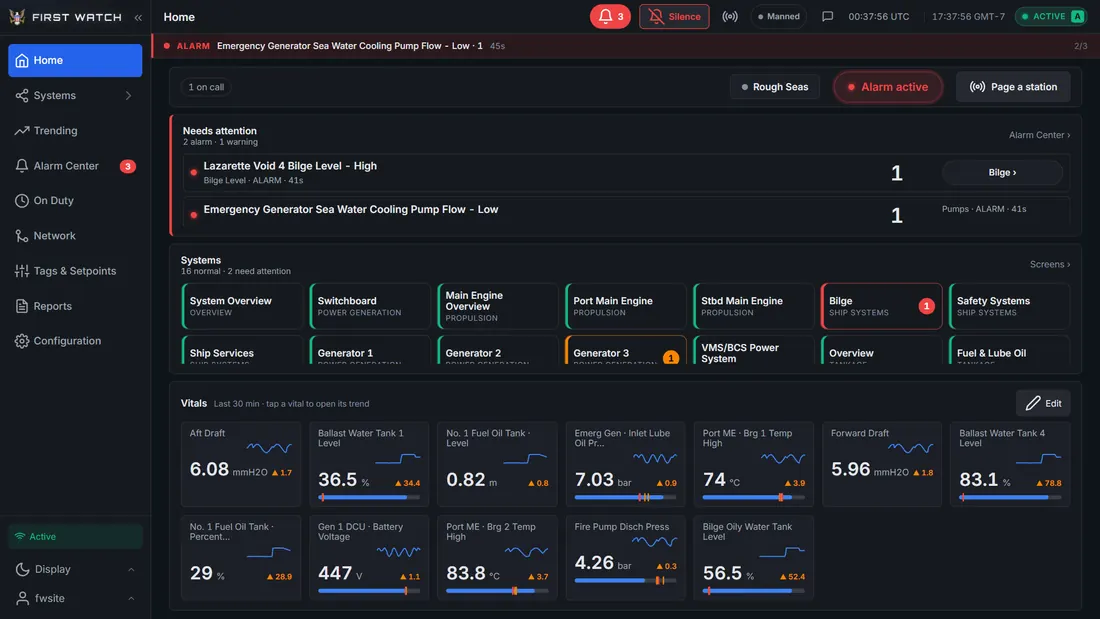
The home screen leads with what needs attention: each alarm with its live value and a one-tap jump to the right system. Every system tile shows its state, and key vitals carry a 30-minute trend. Silence the siren, page a station or the engineer on call, and acknowledge in the Alarm Center with a note.

First Watch Vessel home screen: Needs attention panel listing a lazarette bilge high level alarm and an emergency generator cooling pump low flow alarm, sixteen system tiles colored by status, and live vitals with 30-minute trends

05 · Trending & analytics · Cloud

Go from “something's wrong” to “here's why.”

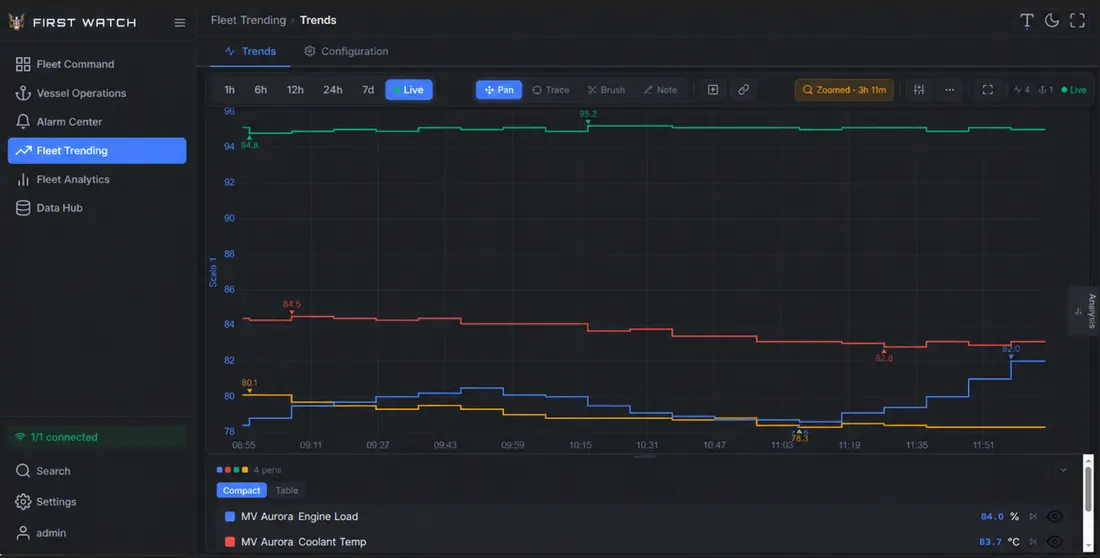
Plot any signal from any vessel on one chart and compare machines side by side. Root-cause analysis ranks what moved around an alarm. Health scores and benchmarking flag the outlier before it fails.

First Watch multi-pen trending chart plotting several engine signals over time

Systems we know

Every system aboard, engineered for your vessel.

Every vessel is different, so every system is engineered for it. These are the systems we monitor, control and automate.

Mains, gears, drives & thrusters

Engines & propulsion

Main engines, reduction gears, propulsion drives and thrusters in front of the watch at the console, with every alarm and running hour visible from the office.

  • Engine, gear and drive monitoring and alarms
  • Running hours and alarm history per vessel
  • Winch and deck machinery status

Generators, switchboards & batteries

Power & switchboards

Generator load, bus voltage and frequency, breakers, battery banks and shore power on one screen aboard, and the same live picture ashore.

  • Generator, switchboard and breaker monitoring
  • Battery and shore-power watch
  • Engine, generator and electrical controls

Gauging, fuel metering & pumps

Tanks, fuel & ballast

Tank gauging, ballast and fuel metering tied into the same alarm system, so the bridge and the office see levels, transfers and fuel burn without a separate system.

  • Tank, ballast, bilge and pump monitoring
  • Fuel burned per vessel and per engine
  • Fleet fuel reporting in First Watch Cloud

Machinery alarm systems

Alarms & safety

Machinery alarm and control systems with ABS / ACCU-classed controls, built to spec and commissioned by our own field team. Fleet analytics show which vessel needs attention first.

  • ABS / ACCU-classed machinery alarm systems
  • Clear alarms on the bridge and in the engine room
  • Alarm history and fleet health scores ashore

Custom requirement? That's most of our work.

Automation, controls and monitoring, from one alarm panel to a fully integrated vessel. We engineer it, build it and install it turnkey.

  • Automation
  • Controls
  • Monitoring
  • Turnkey installs
  • Custom solutions

Built for

Whoever's responsible for the vessel.

Vessel operators

Fleet-wide health scores, fuel and load benchmarking, and ready-made reports for management. Catch the vessel burning more or running hot before it costs you a charter.

Owners & managers

The vessel's condition, fuel burn and alarm history on your phone, without being aboard. See exactly what's running and what it costs, without a single phone call.

Shipyards

A turnkey alarm and monitoring package, with ABS / ACCU-classed controls, panels built in-house and commissioning by our own field team. One subcontractor, one schedule.

Integration

Ties into every major system aboard.

From a few tanks and bilges to hundreds of data points, the system grows with the boat.

  • Engines
  • Generators
  • Electrical
  • Winches
  • Ballast
  • Tank controls
  • Navigation
  • Drives
  • Doors / hatches
  • Bilges
  • Pumps
  • Thrusters

Protocols: NMEA 2000, NMEA 0183, J1939, Modbus TCP/RTU, OPC UA, Siemens S7. Running something else? Ask us.

Security & hosting

Your data stays yours.

  • Encrypted end to end. In transit from vessel to dashboard, and at rest.

  • Isolated and audited. Each customer has its own tenancy, with role-based access down to which vessels a person can see. Every action is logged.

  • Hosted your way. We run it for you on a dedicated, managed AWS environment, or you deploy on your own servers ashore or aboard.

Next step

See your vessel's systems on one screen.

Tell us about your vessel and what you want watched. A marine engineer will map what's possible with the equipment already aboard.